Showing posts with label Vesta. Show all posts

Wednesday, 9 July 2014

The Hybrid Shuttle

Every now and again I get messages from people who need help with their vintage machines. Last week I had a message from a gentleman in Germany who has a Little Vesta minus its shuttle, and he needs to know what he should look for.


This shuttle is from my Little Vesta sewing machine.  The shuttle for my Vesta Transverse Shuttle is identical to this one, and instructions for threading are shown in the Vesta manual.


It is known as a hybrid shuttle, because it is a later development of the boat shuttle, threading in exactly the same way as a shuttle for a vibrating shuttle machine.


It is easy to recognise by its smooth flat side.

This particular shuttle is 4.8 centimetres long and about 1.1 centimetres across (or, for those like me who have a deep seated affection for imperial measurements, one and seven eighths of an inch by seven sixteenths of an inch - more or less).  It is much shorter than the hybrid shuttle for the Frister and Rossmann machines, which are much larger machines.

The first place I always look for bits and pieces for old sewing machines is Helen Howes's excellent website.  She knows more about machines than I ever will.

Saturday, 8 December 2012

Call in the Goblins...


... good, efficient little goblins, as shown in the Vesta manual, who will oil your machine for you when you are not looking.

Then they will thread the shuttle, and go and beat up the naughty elves who tangle up threads in bobbin tins when you forget to secure them with wire tags.

Friday, 7 December 2012

The Vesta Manual


Threading the shuttle made easy, as shown in the manual for the Vesta Cylinder Shuttle machine (a transverse shuttle machine with an enclosed, flat-sided shuttle).

These instructions apply to any make of machine with a similar shuttle.  If your shuttle looks like the one in the picture below (whether or not it has a flat side), then follow these instructions.


These are the best illustrations I have ever seen in an old manual.

Is it a tiny man with a regular sized bobbin and shuttle, or is he normal size and the shuttle is a giant mock-up, for demonstration purposes only?  

I think I know the answer.....

Friday, 9 November 2012

Adjusting the Stitch Length


All my transverse shuttle machines have a sliding knob on the bed of the machine for adjusting the stitch length.  This photo is of the Little Vesta.  The knob is unscrewed a little to allow it to slide from side to side, and is tightened back down into position once the stitch length is adjusted.

When I started work on one of my machines the knob was jammed firm and would not slide until I had given it oil and persuasion over several days.

Often people clean up an old machine with this type of stitch length adjustment and then find that the material will not feed through the teeth when they first try to sew.  They think they have a serious problem with the machine, but then find that they had unwittingly had the stitch length set at nought. If only every problem with a sewing machine were so easy to solve!

Welcome to the latest follower, Littlebear.  Thank you for joining!

Wednesday, 7 November 2012

Oiling a Vesta Sewing Machine


Nothing could be easier.  This photograph shows the Little Vesta, and a previous post showed the same feature on the Vesta Transverse Shuttle machine.  You just find the holes edged in red and put the oil in there.  It saved an awful of of explanation in the manual, if you even have one.

Tuesday, 6 November 2012

The Little Vesta - Disconnecting the Needle for Bobbin Winding


When winding a bobbin it is best to disconnect the main mechanism so the needle does not move. To do this on the Little Vesta, the metal knob on the wheel needs to be pulled out and twisted slightly so that it rests in place in the out position as shown.


By doing this a connecting pin is taken out of the main cog behind the balance wheel, so it no longer turns the smaller cog above it which drives the main cam. This photo shows the hole in the main cog into which the connecting pin fits.

Monday, 5 November 2012

Fascinating Cogs


This is the wheel of the Little Vesta.  The mechanism is exposed, so you can have the delight of watching all the cogs doing their work.  The small cog at the top is for the main cam, and the smaller cog on the left is for the bobbin winder. 

Cleaning this machine was a long and tedious job.  It took hours with an interdental toothbrush to get all the oily rubbish out from between all the cog teeth.

Because the handle is attached directly to the balance wheel, you get only one turn of the wheel to one turn of the handle, whereas machines with the usual handcrank mechanism give three turns of the balance wheel for each turn of the handle.  This is definitely not the machine to use for curtains with a 90 inch drop.

Welcome to Kathiego88 - thank you for following.  Fab avatar!

Friday, 2 November 2012

The Little Vesta


This beautiful Little Vesta, dating from the 1920s or 30s, had the honour of making Little Red Riding Hood.  It seemed to me to be the perfect project for this machine, and was the first item made with with it for decades.


It is a tiny machine.  Sitting the doll next to it makes it look even smaller.

I found this machine over twenty five years ago in a second hand furniture shop.  It was not until we had the internet that I found out where Vesta machines were made and who by.  A good twenty years or more after buying it, I finally hauled it out of the cupboard and cleaned it up.


The next thing to do was try it out.  I was not disappointed, it makes a perfect stitch.  Then came the video.  It all took on a flavour of Watch With Mother with Little Red Riding Hood at the end.

Perhaps I should make another rag doll one day soon.  When I do, I will use this machine again.

Saturday, 28 July 2012

Yet More Wonderful Decals

Just one last picture, and you can play spot the oil hole.  No prizes on offer, but you can claim the glory by posting a comment to say where it is.

Being a true couch potato I sat through last night's Olympic Opening Ceremony and had the incomparable pleasure of seeing the Queen and Daniel Craig taking the art of understatement to its pinnacle.  The video also features a sewing machine.  Here is the link, so you can play at freeze frame in the first few seconds and then dash off furious letters to the props department at the Beeb asking why the handle of the sewing machine was not clicked into position.  And why wasn't it in a base either.

https://www.youtube.com/watch?v=xW5abat5NEU

If you have trouble with the link, search Youtube for "Mr. Bond escorts the Queen."

Hello Gin!  (That's a greeting to the latest follower, not a private conversation into my glass)
And hello Laura Jean who has appeared just this minute!

Friday, 27 July 2012

More Pretty Decals


This picture of the Vesta shows a very helpful feature that Vesta included on their machines.  The holes for lubricating the machine were outlined in red, so there was no chance of wasting oil by ramming it down the wrong hole.

Welcome back to Kmalmquist, and hello Lala!

Thursday, 26 July 2012

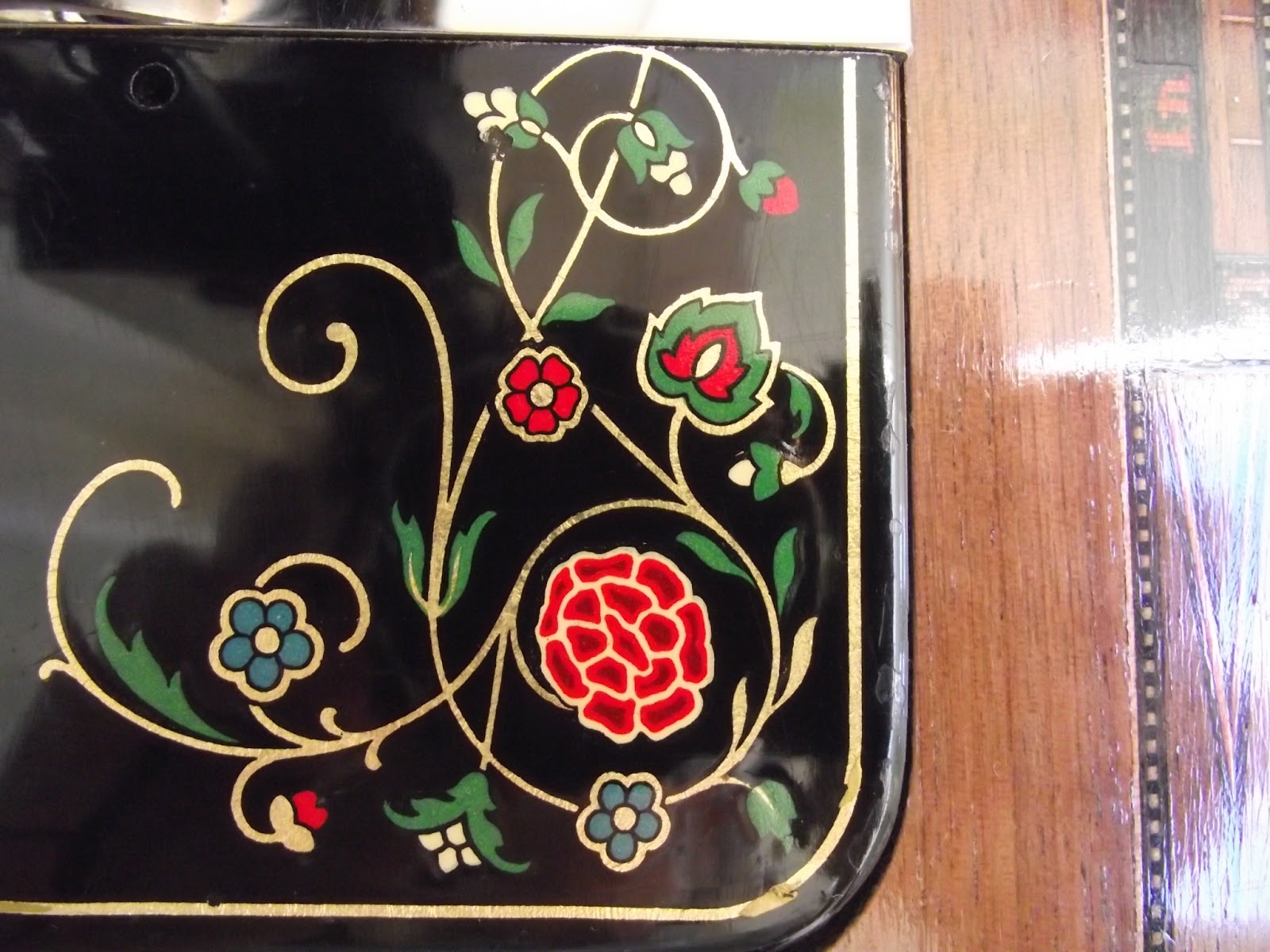
Vesta Decals


First of all, thank you and welcome back to Artymess, Fabriquefantastique and Scott Egerton, who have now reappeared through the cybermaze!


Now feast your eyes on the beautiful designs.  Can't you just imagine them stitched in tiny satin stitch, or woven into brocade, or printed on silk?  Where have you seen similar designs?  This could be a special assignment for Fabriquefantastique.

Somewhere in this house I have an old(ish) little book in German of children in peasant costume, which I should examine with a magnifying glass.  I must dig the book out some time.  I just wish I knew where to start digging.

Wednesday, 25 July 2012

Vesta Transverse Shuttle


They didn't have to make them beautiful, but they did.  Vesta machines have a charm all their own, being built to a smaller scale and with exquisite decals  If you sit this machine beside a Frister and Rossmann the F&R looks an absolute brute and a monster in comparison.

When I bought this machine it had been in the same family since new.  It barely needed cleaning and seems to have been hardly used.  I bring it out from time to time just for the pleasure of looking at it.  The rest of the time it is kept safely away under its cover, away from all the steam and damp that fill English houses and that would soon have any uncovered machine screaming out for the rust remover.

The decals to me look like mid European peasant embroidery.  If anybody ever comes up with pictures of embroidery reminiscent of the design on this machine, please let me know - I will be intrigued.  I will put some close-up pictures of the decals in posts later this week.

LinkWithin

Related Posts Plugin for WordPress, Blogger...